The February 6pm Walk-By: What Shoppers Actually See When Your Lights Are Off
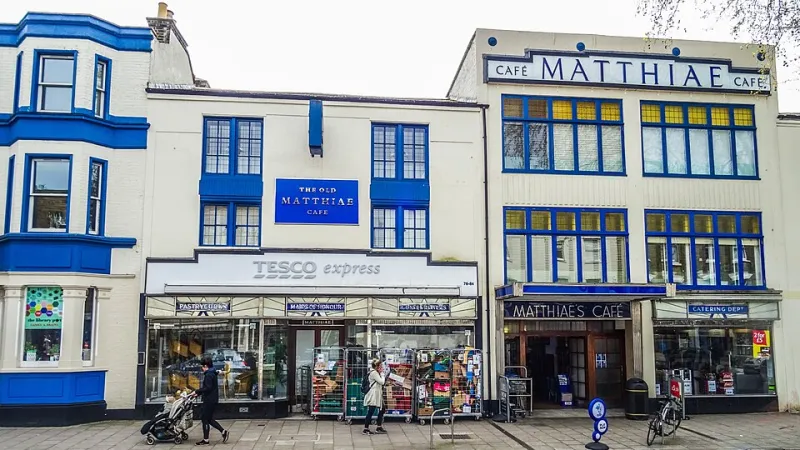
Photo: JOHN K THORNE, CC0, via Wikimedia Commons
Here's a simple experiment. Next time you're closing up, walk fifty metres down the pavement, turn around, and look at your own shop the way a passer-by would at 6pm on a grey February evening. Not from behind the till, not from your parking spot — from the pavement, in the dark, in the rain.
For most of the year, that's the view that matters. Between the clocks going back in late October and the evenings brightening again around March, the bulk of your trading hours happen in darkness or near-darkness. A shopfront that photographs beautifully at midday can be effectively invisible for half the year.
What the Test Actually Reveals
Stand there for a minute. What do you see?
If the answer is "a dark rectangle with some lettering I can only make out because the takeaway next door is lit up," you've just diagnosed the problem. Your neighbour's signage is doing the advertising — for their business. Human eyes are drawn to light, and on a dark high street, attention flows to whatever's illuminated. It's not fair, but it's physics.
The flip side is encouraging: you don't need the brightest sign on the street. You just need to be in the game. A shop that's clearly legible from twenty metres away will catch the eye of someone walking past, even if the unit two doors down has a full halo-lit fascia and a neon window display.
When Lighting Is Money Well Spent
Not every shopfront needs illuminating, but some genuinely do:
- Food, drink and takeaway businesses. Your peak trade is evening trade. If you're not lit, you're not competing.
- Units set back from the pavement or tucked into a parade. Depth and shadow eat unlit signage alive.
- Shops with dark or matt fascias. Navy, black and deep green look premium in daylight and vanish completely at night.
- Anywhere with a competing lit neighbour. If everyone else is lit, being the dark one is a statement — the wrong one.
When You Can Probably Skip It
Conversely, some situations don't justify the spend. A business trading purely 9-to-5 weekdays with no evening or weekend custom — a trade counter, a B2B office, a booking-only studio — gets little from illumination nobody sees. Similarly, if your unit is bathed in light from a supermarket car park or a street lamp directly overhead, a modest refresh of your existing graphics might achieve more than adding lighting to a well-lit fascia.
And if your signage itself is tired? Don't light up a fading fascia. Fix the graphics first, then decide whether they need help being seen.
The Options, From Modest to Full Spec
There's a wide middle ground between "nothing" and "Blackpool illuminations":
Trough lighting — a simple strip of light above the fascia washing down over your lettering. Cheap to install, easy to maintain, and often all a small shop needs. Bulbs and tubes do need replacing, so factor in a bit of maintenance.
LED module systems — low-energy LEDs fitted behind cut-out lettering or within a lightbox. Far cheaper to run than older fluorescent setups, with a lifespan measured in years rather than months.
Halo-lit lettering — individual letters with LEDs hidden behind them, producing a soft glow around each character. It's the premium look, and it suits premium brands: jewellers, salons, solicitors. More upfront cost, but very low running costs and a genuinely distinctive effect after dark.
Illuminated lightboxes — a full panel with your graphics on it, lit from within. Brilliant for uniform brightness, slightly less characterful than built-up lettering.
What It Costs to Run
This is where old assumptions fall apart. A traditional fluorescent trough sign could add a noticeable chunk to your quarterly bill. A modern LED equivalent typically costs pennies a day to run — often less than the kettle in your back office. If someone quotes you on lighting and can't tell you the expected running cost in pounds per year, ask them. Any reputable signage firm will know.
The Planning Wrinkle
Here's the part that catches people out: illuminated signage usually needs advertisement consent from your local council, on top of any permission the sign itself requires. In conservation areas or on listed buildings, expect tighter scrutiny. Some councils are also wary of bright or blinking illumination in residential-adjacent streets.
The good news is that most standard illuminated fascias on a normal high street get approved without drama — but the application takes time, so build it into your schedule rather than hoping it'll slide through in a fortnight. If you're leasing, check your lease too; some landlords restrict illuminated signage or want a say in the design.
The Verdict
Do the 6pm test before you spend a penny. If your shopfront disappears into the February gloom while your competitors glow, illuminated signage isn't a vanity project — it's the difference between being on the street and being part of the scenery. And if it turns out you're already the brightest thing on the block? Well, at least you'll know your money is better spent elsewhere.
Either way, you'll have answered the question with evidence instead of guesswork. That's more than most shopkeepers ever do.